B
BUILD
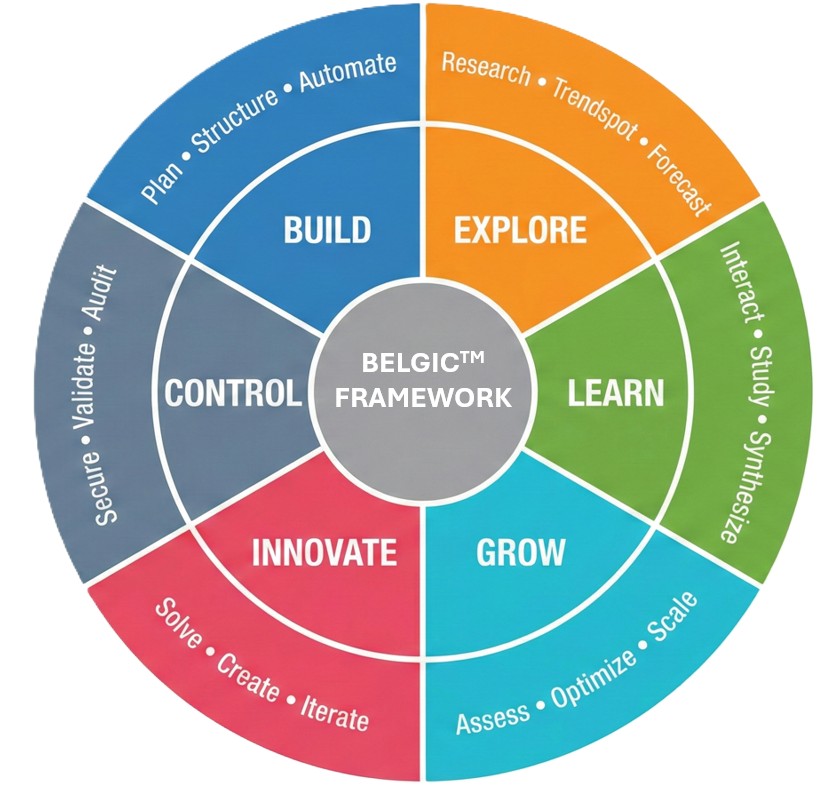
Plan • Structure • Automate
BUILD encompasses the ability to leverage AI for planning, structuring information, and automating workflows. This capability transforms AI from a content generator into a strategic planning partner.
Competency 1
PLAN
Use AI to create project plans, outlines, roadmaps, and strategic frameworks.
Ex: "Create a 6-month product launch timeline with milestones."
Competency 2
STRUCTURE
Organize unstructured data into structured formats, taxonomies, and databases.
Ex: "Convert this report into a structured JSON database."
Competency 3
AUTOMATE
Create workflows, scripts, and automation using AI code generation.
Ex: "Write a Python script to categorize incoming emails."
🎯 Business Impact:
BUILD capability reduces planning time by 60-70%, improves data organization quality, and enables non-technical staff to create automation solutions.
E
EXPLORE
Research • Trendspot • Forecast
EXPLORE represents the ability to use AI as a research assistant, trend analyst, and forecasting tool. This capability transforms information gathering from hours to minutes.
Competency 4
RESEARCH
Conduct literature reviews, competitive analysis, and market research.
Ex: "Summarize last 5 years of research on remote work."
Competency 5
TRENDSPOT
Identify emerging patterns, themes, and trends in data and discourse.
Ex: "Analyze 500 reviews for emerging pain points."
Competency 6
FORECAST
Generate predictions, scenarios, and strategic foresight using AI.
Ex: "Forecast three plausible scenarios for 2027."
🎯 Business Impact:
EXPLORE capability accelerates research cycles by 80%, improves trend identification accuracy, and enables data-driven strategic planning at scale.
L
LEARN
Interact • Study • Synthesize
LEARN focuses on using AI as a personalized tutor, study partner, and knowledge synthesizer. This capability transforms learning from passive consumption to active dialogue.
Competency 7
INTERACT
Engage in Socratic dialogue to test understanding and explore concepts.
Ex: "Act as a Socratic tutor and quiz me on quantum physics."
Competency 8
STUDY
Create study materials, practice problems, and comprehension assessments.
Ex: "Generate 20 practice questions for this chapter."
Competency 9
SYNTHESIZE
Combine multiple sources into coherent summaries and mental models.
Ex: "Synthesize these 5 articles into a unified framework."
🎯 Business Impact:
LEARN capability reduces onboarding time by 50%, improves knowledge retention through active learning, and enables continuous upskilling at individual pace.
G
GROW
Assess • Optimize • Scale
GROW represents meta-skills for improving AI use itself. This capability transforms occasional AI users into power users who continuously refine their practice.
Competency 10
ASSESS
Critically evaluate AI outputs for quality, accuracy, bias, and relevance.
Ex: "Develop rubrics for assessing AI content quality."
Competency 11
OPTIMIZE
Systematically improve prompts, parameters, and workflows.
Ex: "Test prompt variations to find highest quality output."
Competency 12
SCALE
Expand successful AI use cases across teams and workflows.
Ex: "Create prompt libraries for organizational adoption."
🎯 Business Impact:
GROW capability increases AI output quality by 40-60%, reduces iteration time, and enables organizational learning through systematic optimization.
I
INNOVATE
Solve • Create • Iterate
INNOVATE focuses on creative problem-solving, original content generation, and iterative refinement. This capability transforms AI from assistant to creative partner.
Competency 13
SOLVE
Use AI for creative problem-solving, brainstorming, and solution generation.
Ex: "Generate 10 unconventional solutions to reduce churn."
Competency 14
CREATE
Generate original content, designs, and artifacts across multiple formats.
Ex: "Create a multimedia campaign concept with visuals."
Competency 15
ITERATE
Refine ideas through multiple cycles of generation and critique.
Ex: "Improve product concept through 5 iterations."
🎯 Business Impact:
INNOVATE capability increases ideation output by 300%, improves solution novelty, and accelerates time-to-market for new concepts.
C
CONTROL
Secure • Validate • Audit
CONTROL encompasses governance, security, and ethical AI use. This capability transforms AI users from risk creators to risk managers.
Competency 16
SECURE
Protect sensitive data, implement privacy controls, and manage access.
Ex: "Audit prompts for PII leakage before submission."
Competency 17
VALIDATE
Verify AI outputs for factual accuracy and detect hallucinations.
Ex: "Verify all AI-generated claims before publication."
Competency 18
AUDIT
Monitor AI use for bias, fairness, and compliance with policies.
Ex: "Review hiring decisions for demographic bias."
🎯 Business Impact:
CONTROL capability reduces AI-related risks by 90%, prevents data breaches, ensures regulatory compliance, and builds stakeholder trust.